
31 October 1999 - Egyptair 990
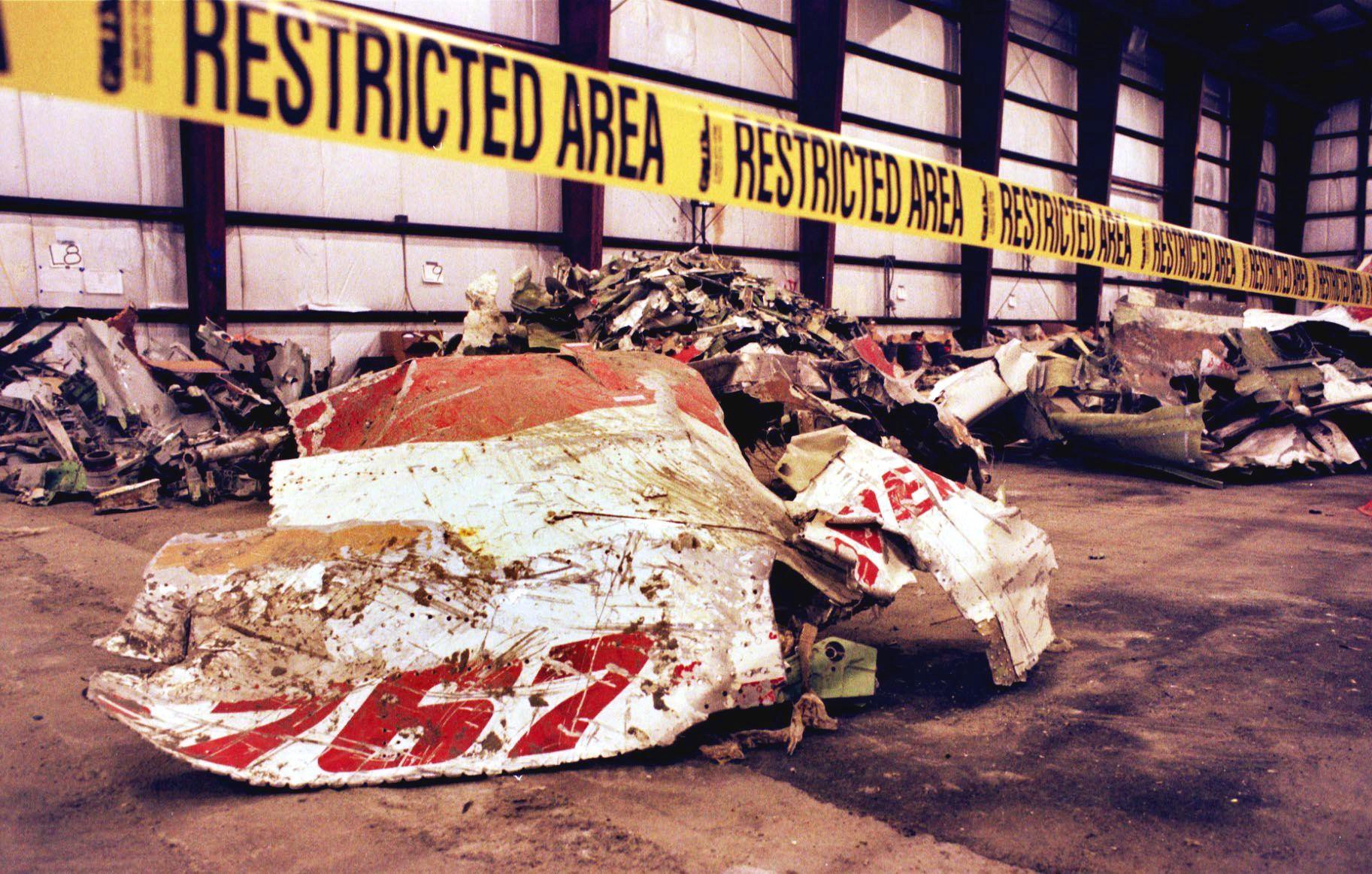
EgyptAir Flight 990 (MSR990) was a regularly scheduled Los Angeles-New York-Cairo flight. On October 31, 1999, at around 01:50 EST, the aircraft, a Boeing 767-366ER aircraft with the registration SU-GAP, named Tuthmosis III after a pharaoh from the 18th Dynasty, plummeted into the Atlantic Ocean, about 60 miles (97 km) south of Nantucket Island, Massachusetts, in international waters, killing all of the 217 people on board.
The exact cause of the crash is disputed. Egyptian investigators concluded that the aircraft crashed as a result of mechanical failure, while U.S. investigators concluded the aircraft was deliberately crashed in an apparent suicide.
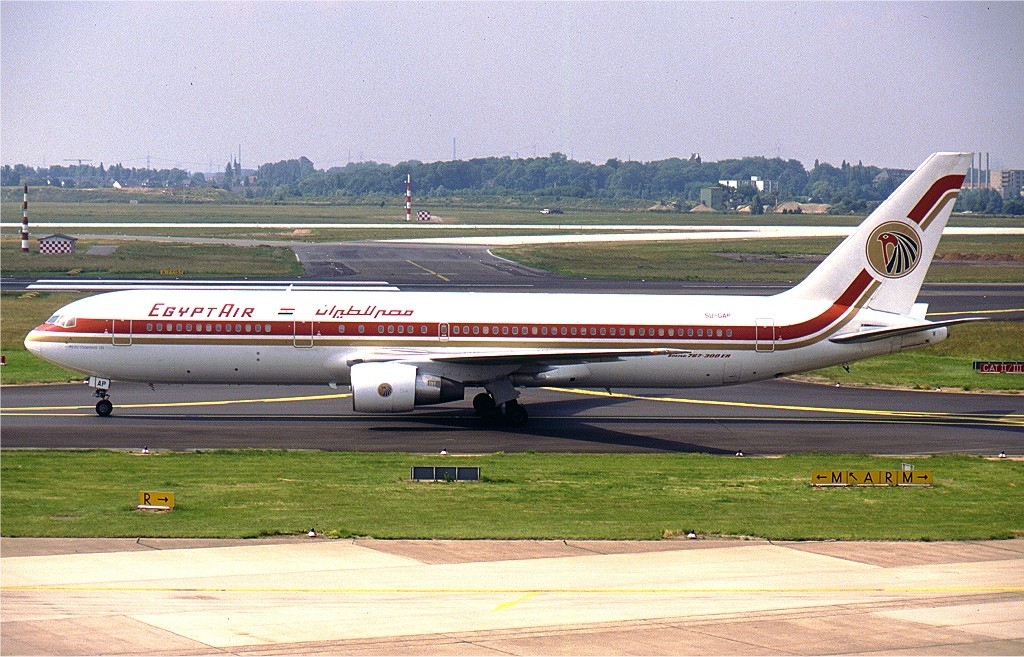
Flight 990 was crewed by 14 people: 10 flight attendants and 4 flight crew members. Because of the scheduled flight time, the flight required two complete flight crews (each consisting of one captain and one first officer). EgyptAir designated one crew as the "active crew" and the other as the "cruise crew" (sometimes also referred to as the "relief crew"). It was customary for the active crew to make the takeoff and fly the first four to five hours of the flight. The cruise crew then assumed control of the aircraft until about one to two hours prior to landing, at which point the active crew returned to the cockpit and assumed control of the airplane. EgyptAir designated the captain of the active crew as the Pilot-in-Command or the Commander of the flight. The active crew consisted of Captain Mahmoud El Habashy and First Officer Adel Anwar, and the cruise crew were Captain Amal El Sayed and First Officer Gameel Al-Batouti (the NTSB reports use the spelling "El Batouty").
While the cruise crew was intended to take over far into the flight, Batouti recommended that he relieved Anwar twenty minutes after takeoff. Anwar initially protested, but eventually agreed.
U.S. Air Traffic Controllers provide transatlantic flight control operations as a part of the "New York Center" (referred to in radio conversations simply as "Center" and abbreviated in the reports as "ZNY"). The airspace is divided into "areas," and "Area F" was the section that oversaw the airspace through which Flight 990 was flying. Transatlantic commercial air traffic travels via a system of routes called North Atlantic Tracks, and Flight 990 was the only aircraft at the time assigned to fly North Atlantic Track Zulu. There are also a number of military operations areas over the Atlantic, called "Warning Areas," which are also monitored by New York Center, but records show that these were inactive the night of the accident.
Interaction between ZNY and Flight 990 was completely routine. After takeoff, Flight 990 was handled by three different controllers as it climbed up in stages to its assigned cruising altitude.
The aircraft, like all commercial airliners, was equipped with a Mode C transponder, which automatically reported the plane's altitude when queried by the ATC radar. At 01:44, the transponder indicated that Flight 990 had leveled off at FL330. Three minutes later, the controller requested that Flight 990 switch communications radio frequencies for better reception. A pilot on Flight 990 acknowledged on the new frequency. This was the last transmission received from Flight 990.
The records of the radar returns then indicate a sharp descent: The times which begin 06: appear to be in Greenwich Mean Time (GMT) or Coordinated Universal Time (UTC), which is 5 hours ahead of United States Eastern Standard Time (EST), explaining the difference between other time references here that begin 01:.
06:49:53Z — FL329
06:50:05Z — FL315
06:50:17Z — FL254
06:50:29Z — FL183 (this was the last altitude report received by ATC)
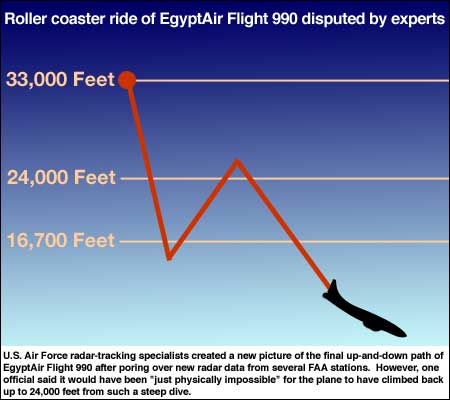
The plane dropped 14,600 feet (4,500 m) (nearly three miles) in 36 seconds. Several subsequent "primary" returns (simple radar reflections without the encoded Mode C altitude information) were received by ATC, the last being at 06:52:05. At 06:54, the ATC controller tried notifying Flight 990 that radar contact had been lost, but received no reply.
Two minutes later, the controller contacted ARINC to determine if Flight 990 had switched to an oceanic frequency too early. ARINC attempted to contact Flight 990 on SELCAL, also with no response. The controller then contacted a nearby aircraft, Lufthansa Flight 499, asking it to see if it could raise Flight 990. The German carrier responded that it had no radio contact and was not receiving any ELT signals. Air France Flight 439 was asked to overfly the last known position of Flight 990, but reported nothing out of the ordinary. Center also provided coordinates of Flight 990's last-known position to Coast Guard rescue aircraft.
Flight Data later showed that the flight controls were used to move the elevators in order to initiate and sustain the steep dive. The flight deviated from its assigned altitude of 33,000 feet (10,000 m) (FL330) and dived to 16,000 feet (4,900 m) over 44 seconds, then climbed to 24,000 feet (7,300 m) and began a final dive, hitting the Atlantic Ocean about two and a half minutes after leaving FL330. Radar and radio contact was lost 30 minutes after the aircraft departed JFK Airport in New York on its flight to Cairo.
The cockpit voice recorder (CVR) recorded the Captain excusing himself to go to the bathroom, followed thirty seconds later by the First Officer saying, "I rely on God." A minute later, the autopilot was disengaged, immediately followed by the First Officer again saying, "I rely on God." Three seconds later, the throttle for both engines was reduced to zero, and both elevators were moved three degrees, nose down. The First Officer repeated "I rely on God" six more times before the Captain is suddenly heard to ask repeatedly, "What's happening, what's happening?" The flight data recorder reflected that the Captain then commanded the nose up while the First Officer commanded the nose down, at the same time as the engines were shut down. The Captain asked, "What is this? What is this? Did you shut the engines?" There were no other aircraft in the area. There was no indication that an explosion occurred on board. The engines operated normally for the entire flight until they were shut down. The left engine was later torn from the wing by the stress of the dive.
Under the International Civil Aviation Organization treaty, the investigation of an airplane crash in international waters is under the jurisdiction of the country of registry of the aircraft. At the request of the Egyptian government, the U.S. National Transportation Safety Board (NTSB) took the lead in this investigation, with the Egyptian Civil Aviation Authority (ECAA) participating. The investigation was supported by the Federal Aviation Administration, the Federal Bureau of Investigation, the United States Coast Guard, the U.S. Department of Defense, the National Oceanic and Atmospheric Administration, Boeing Commercial Airplanes, EgyptAir, and Pratt & Whitney Aircraft Engines.
Two weeks after the crash, the NTSB proposed declaring the crash a criminal event and handing the investigation over to the FBI. Egyptian government officials protested, and Omar Suleiman, head of Egyptian intelligence, traveled to Washington to join the investigation.
Investigation conclusions:
The NTSB's final report was issued on 21 March 2002, after a two-year investigation. Their conclusion was:
“ The National Transportation Safety Board determines that the probable cause of the EgyptAir flight 990 accident is the airplane's departure from normal cruise flight and subsequent impact with the Atlantic Ocean as a result of the relief first officer's flight control inputs. The reason for the relief first officer's actions was not determined. ”
The ECAA's final report, based largely on the NTSB's, came to different conclusions:
“ 1. The Relief First Officer (RFO) did not deliberately dive the airplane into the ocean. Nowhere in the 1,665 pages of the NTSB’s docket or in the 18 months of investigative effort is there any evidence to support the so called “deliberate act theory.” In fact, the record contains specific evidence refuting such a theory, including an expert evaluation by Dr. Adel Fouad, a highly experienced psychiatrist.
2. There is evidence pointing to a mechanical defect in the elevator control system of the accident. The best evidence of this is the shearing of certain rivets in two of the right elevator bellcranks and the shearing of an internal pin in a power control actuator (PCA) that was attached to the right elevator. Although this evidence, combined with certain data from the Flight Data Recorder (FDR), points to a mechanical cause for the accident, reaching a definitive conclusion at this point is not possible because of the complexity of the elevator system, the lack of reliable data from Boeing, and the limitations of the simulation and ground tests conducted after the accident. Additional evidence of relevant Boeing 767 elevator malfunctions in incidents involving Aero Mexico (February 2000), Gulf Air, and American Airlines (March, 2001). There were also two incidents on a United Airlines airplane in 1994 and 1996.
3. Investigators cannot rule out the possibility that the RFO may have taken emergency action to avoid a collision with an unknown object. Although plausible, this theory cannot be tested because the United States has refused to release certain radar calibration and test data that are necessary to evaluate various unidentified radar returns in the vicinity of Flight 990.
Download the Cockpit Voice Recorder transcript
Search the database
