
27 January 2009 - Empire Airlines 8284
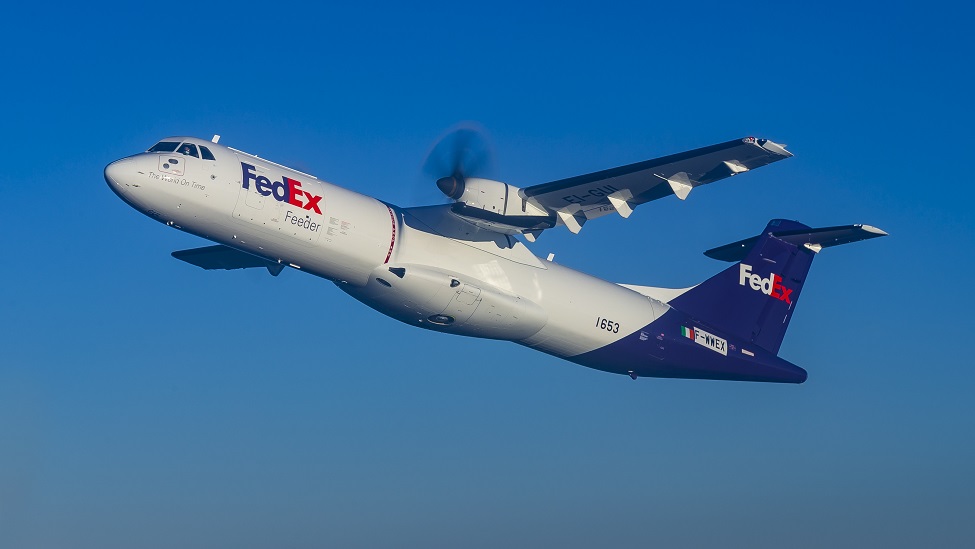
On January 27, 2009, approximately 0437 central standard time, N902FX, an Aerospatiale Alenia ATR-42-320, operating as Empire Airlines flight 8284, sustained substantial damage when it landed short of the runway threshold while executing the Instrument Landing System (ILS) RWY 17R approach at Lubbock Preston Smith International Airport (LBB), Lubbock, Texas. The airplane was registered to Federal Express Corporation, Memphis, Tennessee, and operated by Empire Airlines, Hayden, Idaho. The airline transport pilot rated captain was seriously injured and the commercial rated first officer sustained minor injuries. An instrument flight rules flight plan was filed for the flight that departed Fort Worth Alliance Airport (AFW), Fort Worth, Texas, approximately 0319. Night instrument meteorological conditions prevailed for the supplemental cargo flight operated under 14 Code of Federal Regulations Part 121.
A preliminary review of air traffic control communications revealed that the captain contacted the Lubbock Air Traffic Control Tower (ATCT) at 0422, and reported that they were descending from an altitude of 10,000 feet down to 8,000 feet mean sea level (msl). A controller acknowledged the transmission and then provided the airport's current weather information and a runway breaking-action advisory. In addition, he provided vectors for the ILS 17R approach.
At 0430, the controller instructed the airplane to descend and maintain an altitude of 5,000 feet msl. At 0432, the controller informed the flight crew that the wind had shifted 180 degrees from the north to the south between 5,000 and 6,000 feet msl. The captain responded and added that he also noted a drop in the outside air temperature of 8 degrees and concurred with the controller's observation regarding the wind shift. The controller cleared the airplane for the ILS approach at 0433 and instructed the flight crew to contact Lubbock Control Tower. The captain acknowledged.
At 0434, the captain contacted the control tower and a controller cleared the airplane to land on runway 17R. The captain acknowledged the landing clearance and there were no further communications. Approximately three minutes later an airport maintenance employee contacted the tower and asked "what is that fire there at the end of the runway?" A controller responded, "it's an airplane." The controller had witnessed the accident and had activated the alarm for the airport rescue and fire fighting equipment to respond.
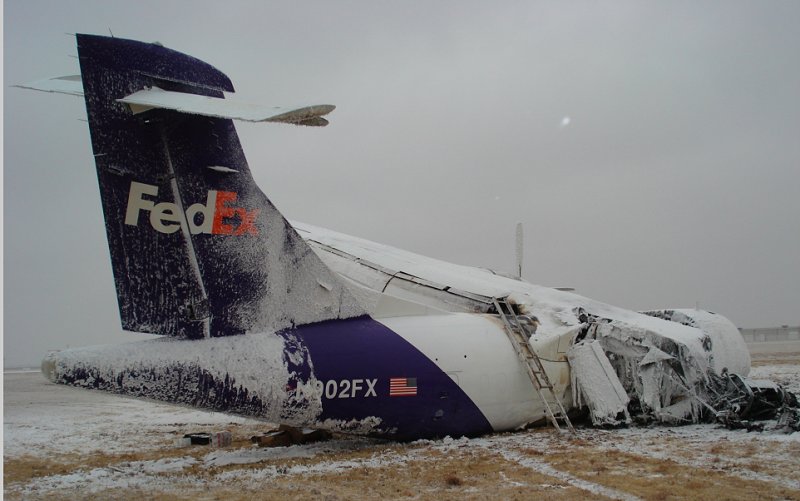
An on-scene examination of the wreckage revealed that the airplane landed short of the runway threshold and collided with the approach lighting system before it skidded off the right side of the runway into the grass. The airplane came to rest on a westerly heading perpendicular to the runway. A post-impact fire consumed a large portion of the fuselage and the right wing.
At 0415, the special weather report at LBB included wind from 350 degrees at 10 knots, visibility 2 miles, light freezing drizzle, mist, ceiling 500 feet overcast, temperature 46 degrees Fahrenheit, dew point 48 degrees Fahrenheit, and a barometric pressure setting of 30.02 inches of Mercury.
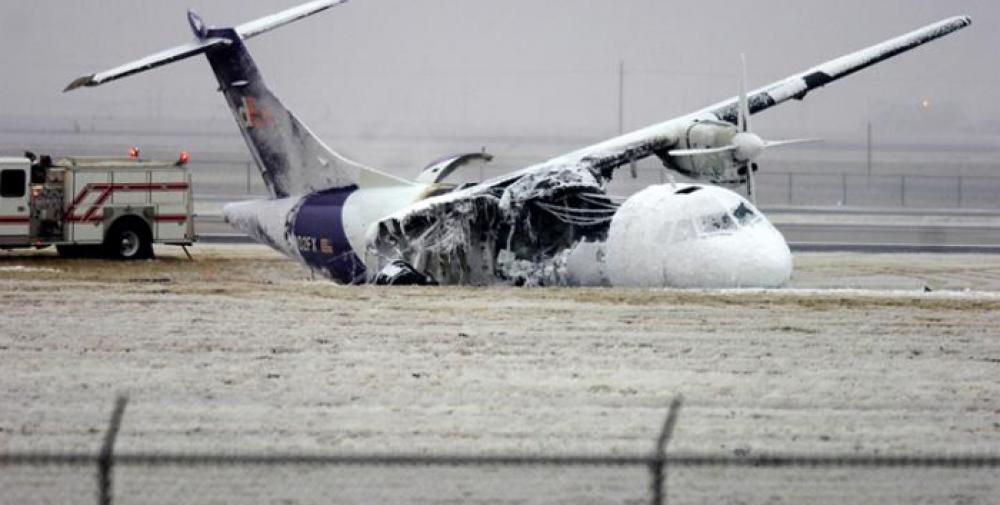
The National Transportation Safety Board (NTSB) investigated the cause of the accident. The flight data recorder and cockpit voice recorder showed that the crew continued the landing after the flaps failed to deploy rather than conducting a go-around. The crew also failed to apply maximum engine thrust immediately after the stall, waiting 17 seconds after an TAWS warning had sounded before applying thrust. In post-accident interviews, the captain said that he had sleep fatigue before the flight due to "high-workload situations" which affected his performance. After the investigation was completed the NTSB released their final report in 2011. It concluded with investigators stating that "The National Transportation Safety Board determines that the probable cause of this accident was the flight crew's failure to monitor and maintain a minimum safe airspeed while executing an instrument approach in icing conditions, which resulted in an aerodynamic stall at low altitude. Contributing to the accident were 1) the flight crew's failure to follow published standard operating procedures in response to a flap anomaly, 2) the captain's decision to continue with the unstabilized approach, 3) the flight crew's poor crew resource management, and 4) fatigue due to the time of day in which the accident occurred and a cumulative sleep debt, which likely impaired the captain's performance."
Transcript of the Cockpit Voice Recorder (CVR)
04:34:01 RDO-1: Empire eighty two eighty four is uh checkin' in nine out on the localizer inbound.
04:34:06 TWR: Empire eighty two eighty four Lubbock Tower runway one seven right clear to land. winds zero one zero at eight.
04:34:11 RDO-1: roger clear to land.
04:34:14 HOT-2: alright...go.
04:34:24 HOT-2: flaps fifteen gear down landing check.
04:34:29 CAM: [sound similar to landing gear deployment]
04:34:33 HOT-1: alright awww landing check. start selector is continuous relight. power management is in takeoff. icing AOA is on landing gear confirmed three green.
04:34:43 HOT-2: glideslope star.
04:34:48 HOT-2: confirmed.
04:34:48 HOT-1: uh let's see we should have glideslope star.
04:34:52 HOT-1: very good...and flaps condition levers to go.
04:34:58 HOT: [sound similar to altitude alert]
04:35:03 HOT-2: what the heck is going on?
04:35:04 HOT-1: you know what? we have no flaps.
04:35:08 HOT-2: aw #.
04:35:10 LB: [sound similar to outer marker]
04:35:22 TAWS: one thousand.
04:35:23 HOT-2: okay.
04:35:28 HOT-1: what the hell?
04:35:30 HOT: [sound similar to stall warning and stick-shaker lasting 1.1 seconds]
04:35:31 HOT-2: aw #.
04:35:31 HOT-1: yeah don't do that.
04:35:32 CAM: [sound similar to stall warning lasting 0.3 seconds]
04:35:34 HOT-2: alright.
04:35:36 HOT-1: just keep flying the airplane. okay.
04:35:40 HOT-2: should I go around?
04:35:41 HOT-1: no.
04:35:41 TWR: winds zero one zero at eight.
04:35:43 HOT-1: keep descending.
04:35:44 HOT-2: we're getting pretty close here. [straining]
04:35:45 HOT-1: what's that? you want me to finish it?
04:35:47 HOT-2: yes please.
04:35:48 HOT-1: okay my airplane.
04:35:49 HOT-2: your controls.
04:35:50 HOT-?: [sound of heavy breathing]
04:35:52 HOT-2: alright you got power.
04:35:53 HOT: [sound similar to altitude alert]
04:35:58 TAWS: five hundred.
04:36:00 HOT-1: aw #.
04:36:00 HOT: [sound similar to stall warning and stick-shaker lasting 0.9 seconds]
04:36:00 TAWS: pull up. pull up.
04:36:02 HOT-1: okay.
04:36:04 HOT-2: there's the runway.
04:36:17 HOT-1: max RPM.
04:36:17 HOT-2: max RPM.
04:36:19 CAM: [sound similar to RPM increase]
04:36:19 HOT: [sound similar to stall warning and stick-shaker lasting 0.5 seconds]
04:36:20 HOT: [sound similar to stall warning and stick-shaker lasting 5.4 seconds]
04:36:22 HOT-2: oh #.
04:36:25 HOT-1: #.
04:36:25 HOT-2: #. [straining]
04:36:27 CAM: [sound of impact]
04:36:28 CAM: [sound of grinding and scraping]
04:36:32 CAM: [sound of continuous repetitive chime continues until end of recording]
04:36:43 CAM: [sound similar to occupants moving around in cockpit]
04:36:45 HOT-1: get out of the airplane. get out of the airplane.
04:36:48 CAM: [sound of scraping stops]
04:36:52 CAM-1: go out the— go out the hatch.
Search the database
